
What Do CE Ratings in Motorcycle Gear Actually Mean?

CE ratings in motorcycle gear help riders understand how protective equipment performs under specific safety tests. However, not every CE label means the same thing. Armor, jackets, pants, and gloves can follow different standards, so knowing what to check helps you make a better buying decision.
Before choosing your next riding jacket or pair of pants, learn the difference between Level 1 and Level 2 armor, garment safety classes, and the labels on protective equipment.
What Does CE Mean in Motorcycle Gear?
CE stands for Conformité Européenne. The CE marking indicates that a product meets the applicable European Union requirements for that product category. For motorcycle protective equipment, the relevant standards depend on the type of gear and the protection it provides.
The important point is that CE-rated armor and CE-certified clothing are not necessarily the same thing. A jacket may contain certified impact protectors, but that alone does not establish the safety class of the entire garment.
What Is the Difference Between CE Level 1 and Level 2 Armor?
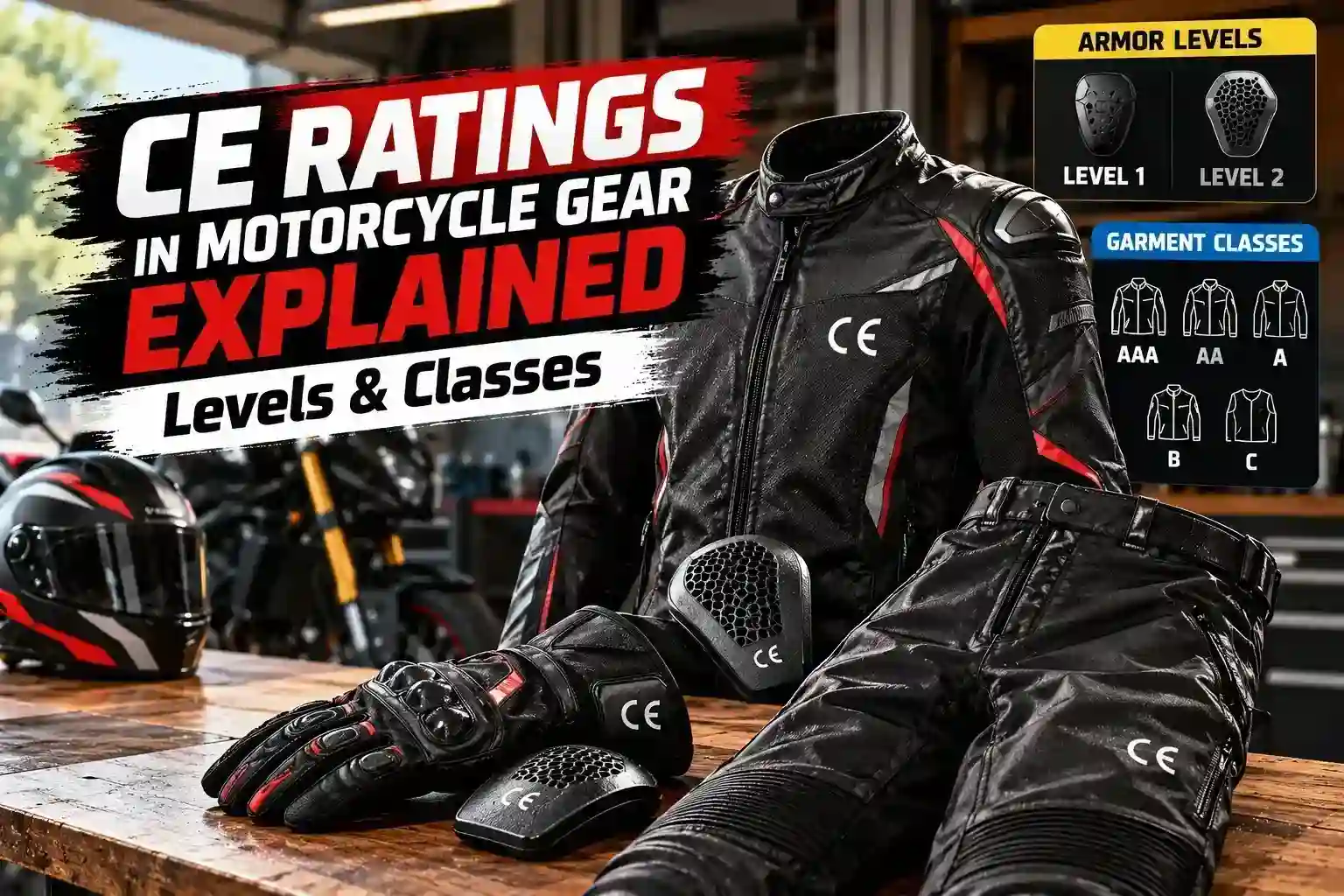
CE Level 1 and Level 2 are commonly used to describe the impact-protection performance of motorcycle armor. Under EN 1621-1, which covers limb-joint protectors, Level 2 allows less force to pass through the protector during standardized impact testing than Level 1.
- Level 1 armor: Usually offers a lighter, more flexible option for riders who value comfort and mobility.
- Level 2 armor: Meets stricter impact-transmission limits and generally provides a higher level of impact protection.
The right choice depends on the protector, its fit, and your riding needs. Check the product specifications carefully, as standards for back, chest, and limb protectors differ.
What Do AAA, AA, A, B, and C Ratings Mean?
Motorcycle garments may be tested under the EN 17092 standard series, which classifies protective clothing according to its construction and performance requirements.
| Garment class | General meaning |
| AAA | Highest protection class within this garment classification |
| AA | Higher protection requirements than Class A |
| A | Protective clothing designed to balance protection and comfort |
| B | Abrasion protection without the impact protection provided by an integrated protector |
| C | Clothing designed to hold impact protectors, without providing the same abrasion coverage as other classes |
These classes are not the same as armor’s Level 1 and Level 2 ratings. A garment class describes the performance of the clothing, while an armor level describes a protector’s impact performance.
How Do CE Ratings Apply to Motorcycle Jackets and Pants?
When shopping for a jacket or motorcycle pants, check both the garment’s protective performance and the armor it includes. A jacket with Level 2 shoulder armor does not automatically mean the whole jacket is Class AA or AAA.
Look for the garment’s declared standard and class, the locations of its protectors, and whether those protectors are removable. Fit also matters because armor that shifts away from the intended body area may not provide the expected coverage.
Six-Gear offers different styles of motorcycle jackets and pants, including mesh and textile options. Compare each product’s listed protective features rather than assuming every model has the same certification or armor level.
Do CE Ratings Matter for Motorcycle Gloves?
Yes. Motorcycle gloves may be assessed under EN 13594, a standard specifically for protective gloves for motorcycle riders. Depending on the model and its certification, the standard addresses features such as protective performance and resistance to mechanical risks.
When comparing gloves, check the product’s certification details, fit, wrist coverage, and protective features. Do not assume that a glove is certified simply because its description uses words such as “protective” or “reinforced.”
Are CE Ratings the Same as DOT or ECE Helmet Ratings?
No. CE marking for protective clothing and armor is different from motorcycle helmet approval requirements.
In the United States, DOT refers to the applicable federal motor vehicle safety standard for helmets. ECE helmet approvals follow United Nations regulations, such as UN Regulation No. 22. These are separate from the EN standards commonly used for motorcycle clothing and armor.
When buying a helmet, check the specific approval marking required in your country. Do not use a jacket’s CE rating or an armor level as evidence that a helmet meets a particular helmet standard.
How Can You Choose Motorcycle Gear With the Right CE Rating?
Start by identifying the kind of protection you need. Then check the garment’s safety class, the armor’s rating, and whether the protectors cover the correct areas.
Also consider fit, ventilation, weather conditions, and how often you ride. A higher rating can be valuable, but gear still needs to fit properly and remain comfortable enough for you to wear consistently.
Before buying, read the manufacturer’s specifications and look for clear certification details. Avoid relying on a CE logo or marketing claim without checking what product or component it applies to.
Final Thoughts
Understanding CE ratings in motorcycle gear helps you compare products more accurately. Remember that Level 1 and Level 2 describe armor performance, while AAA, AA, A, B, and C classify motorcycle garments under a different standard.
Check the certification details for each item, make sure the gear fits correctly, and choose protection suited to your riding conditions. Looking beyond the label helps you make a more informed decision about your riding equipment.