

Motorcycle Glove Size Guide for Riders

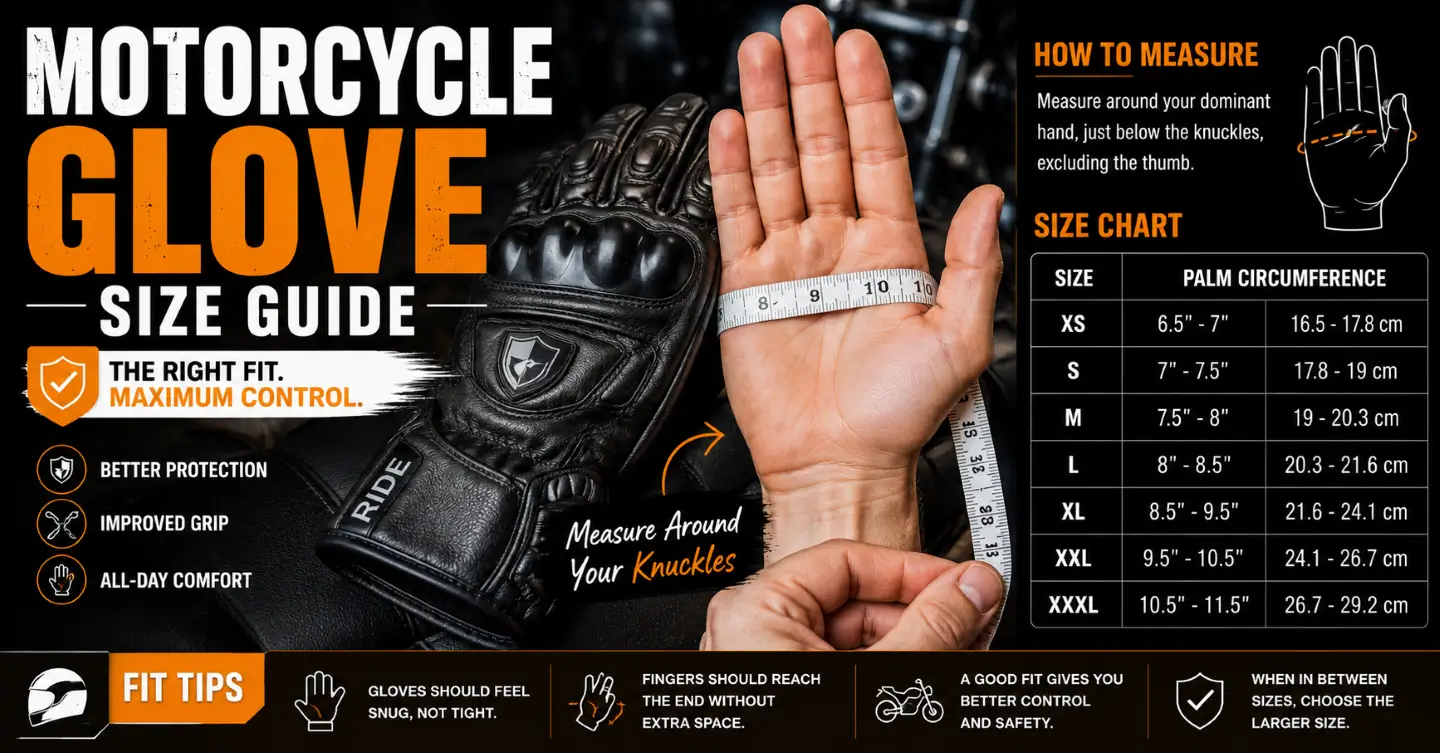
The only measurement that matters when sizing motorcycle gloves is your palm circumference taken at the widest point just below the knuckle line. That one number, matched against a brand’s size chart, tells you exactly which glove fits.
Trying to go off your jacket size or shirt size almost always ends in the wrong result. And the wrong glove shifts in a slide, pulling the protective armor off your knuckles at precisely the moment it needs to be there.
How Fit Actually Affects Your Safety
A glove that runs too loose moves around in a crash, pulling the CE armor out of position when impact resistance counts most. One that’s too tight cuts off blood circulation and causes numbness within 20 to 30 minutes on the bike. Both are distractions you don’t need at speed.
The fit test that actually works isn’t making a fist. Put the gloves on and grip a real motorcycle handlebar. Your fingers shouldn’t bunch at the tips, and the palm should lay flat without extra material bunching underneath. That grip position reflects your actual hand shape while riding. A closed fist doesn’t replicate it.
Measuring Your Hand for Motorcycle Gloves
Use a soft flexible measuring tape. Wrap it around the palm of your dominant hand at the widest point just below the knuckles that do not include the thumb. Write it down in inches. Do both hands and go with the larger number; hands are rarely symmetrical, and sizing to the bigger one keeps the fit right on your dominant side.
Most American brands use letter sizing from XS through XXL based on palm circumference. European brands run numerical sizing from 6 to 13. Always check the specific brand’s chart and do not assume any conversion between systems. Six Gear’s glove collection includes sizing charts for each style directly on the product page.
Standard US sizing as a general starting point:
| Palm Circumference | US Glove Size |
| Under 7.0 inches | XS |
| 7.0 – 7.5 inches | S |
| 7.5 – 8.0 inches | M |
| 8.0 – 8.5 inches | L |
| 8.5 – 9.0 inches | XL |
| Over 9.0 inches | XXL |
Still verified against the specific brand chart, individual styles can vary by a full size depending on padding thickness and construction differences.
Reading a Motorcycle Glove Size Chart
Most charts reference palm circumference at the widest point. Sport and racing gloves sometimes add finger length as a second measurement. If your measurement lands at the upper end of a size bracket, expect a snug fit right out of the box. If it lands near the lower end, you’ll have slightly more room initially.
The Six Gear size chart reference covers palm measurements across gloves and other gear. Two gloves from different brands listed at the same nominal size can still fit differently depending on pre-curved finger construction, knuckle guard placement, and lining thickness. When in doubt, size up.
Leather vs Textile Gloves and How They Size Differently
Leather motorcycle gloves stretch about 5 percent during break-in as the hide conforms to your hand over the first few rides. Buy them slightly snug when new. A leather glove that has room to spare at purchase shifts around after break-in and loses tactile feel on the controls.
Textile motorcycle gloves hold their shape throughout the product’s life. If a textile glove fits right out of the box, that’s your correct size if it feels even a little tight, size up. Cold-weather textile gloves with added insulation or a waterproof membrane reduce interior space further, so size up by half a size from your base palm measurement to keep finger movement comfortable when you’re running thermal underlayers.
Glove Types and How Each Fits
Racing and sport gloves run aggressive pre-curved fingers and a narrower palm box for maximum throttle sensitivity and lever feel. The fit will feel noticeably tighter than a touring glove at the same nominal size. That’s intentional; it’s built around sport and track demands.
Touring gloves run more relaxed to handle all-day comfort and accommodate liner gloves when temperatures drop. Cold-weather motorcycle gloves need the most attention at sizing. Insulation and waterproof membranes reduce usable interior space by roughly half a size compared to the glove’s external dimensions; always try them on with the liner inside before committing.
American vs European Sizing
American-cut gloves carry a more relaxed profile across the palm and finger box. European-cut gloves run narrower and more aggressively proportioned. A rider switching from an American brand to a European one typically needs to go up a full size to get the same functional fit and vice versa going the other direction.
Women’s-specific gloves account for the proportional difference between female and male hand shapes. Women’s hands generally have longer, more slender fingers relative to palm width, and women’s-specific designs handle that palm-to-finger ratio better. Where both versions are available, try them side by side before ordering online.
FAQs
How do you measure hand size for motorcycle gloves?
Wrap a soft measuring tape around the palm of your dominant hand at the widest point just below the knuckles, excluding the thumb. Use the larger measurement if both hands differ. Match that number against the specific brand’s size chart for the most accurate result.
Should motorcycle gloves fit tight or loose?
Snug without cutting circulation or limiting finger movement. Leather gloves should feel slightly firm when new and stretch around 5 percent during break-in. Textile gloves should fit correctly from day one so they don’t stretch over time.
What is palm circumference for glove sizing?
It’s the measurement around the widest part of your hand just below the knuckles, thumb excluded. Most motorcycle glove brands use this as the primary sizing factor across all their product lines.